Payroll Is Where a Mistake Lands in Someone's Bank Account
Most Sri Lankan employers still run payroll on spreadsheets, or on a system that was installed years ago and never properly used. Here's what peer-reviewed research in Sri Lanka and abroad says about computerising payroll and HR: what holds businesses back, what makes the software actually get used, and what it costs when payroll goes wrong.
In summary, the barriers aren't what most people think. In the Sri Lankan studies, cost and technical knowledge weren't the deciding factors. Staff training and management support were. And once a system is installed, whether people use it comes down almost entirely to whether the top of the organisation visibly backs it.
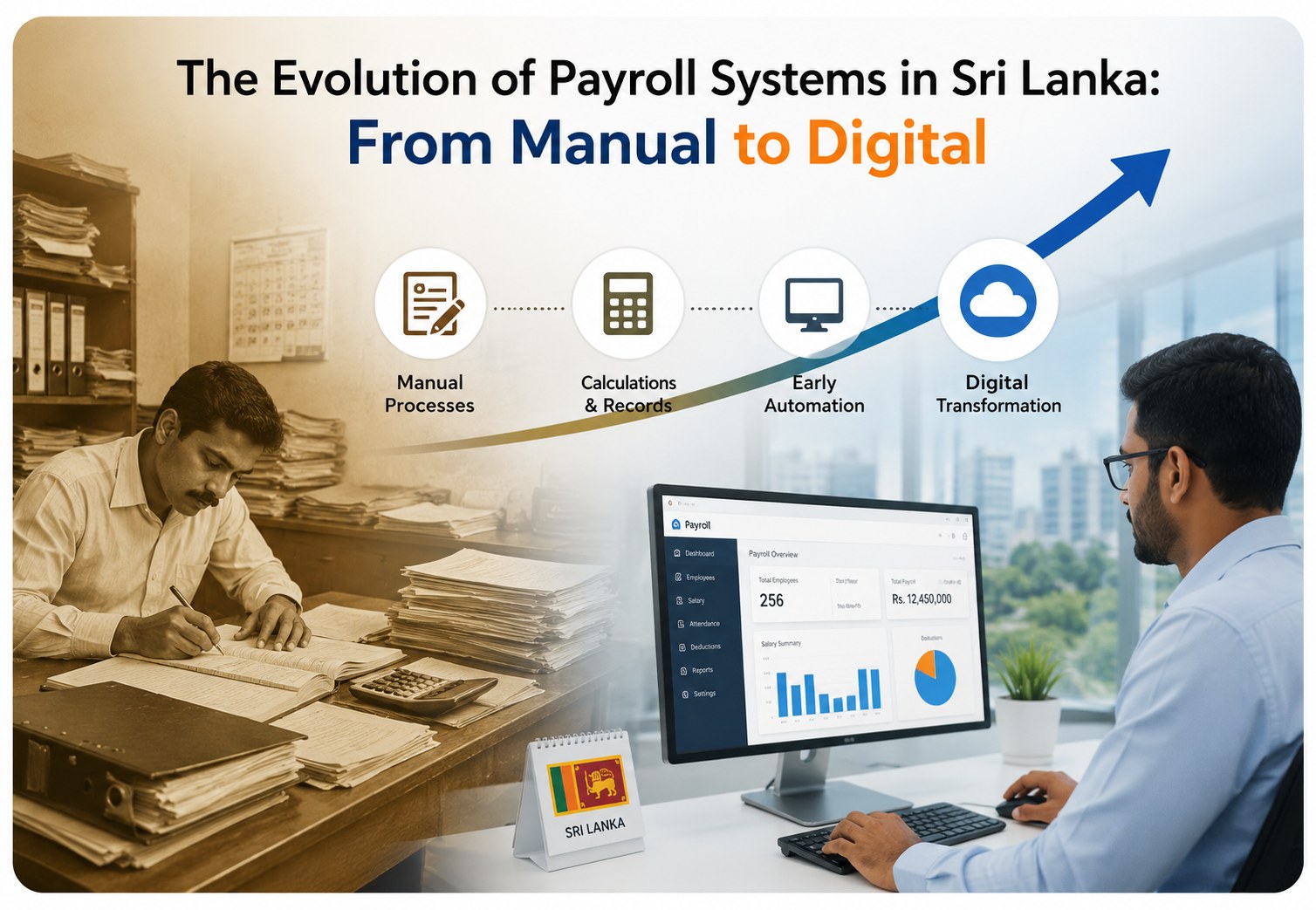
Compared to accounting software, the research done on payroll software specifically is far less, so where a study covers HR information systems (HRIS) more broadly, we say so. Payroll is a core module of every HRIS the studies looked at. Every source below is linked. See also our earlier piece on the evolution of payroll systems in Sri Lanka.
What Stops Small Businesses Computerising Payroll and HR?
In 2022, a team at SLIIT Business School surveyed 300 owners and managers of micro, small and medium enterprises in the Western Province about the challenges of implementing an HR information system (SLIIT Business Review). They tested four factors: staff training, management support, cost of maintenance, and technical knowledge.
Taken together, the four explained 80% of the variation in HRIS implementation. But when tested at the same time, only two held up:
| Challenge | Standardised effect (β) | Significant? |
|---|---|---|
| Staff training | 0.782 | Yes (p < 0.001) |
| Management support | 0.150 | Yes (p = 0.006) |
| Cost of maintenance | N/A | No (p = 0.60) |
| Technical knowledge | N/A | No (p = 0.59) |
Staff training is the biggest factor by a wide margin, almost five times the effect of management support. The two reasons business owners most often give for not computerising, cost and technical knowledge, made no significant difference once training and support were taken into account.
What Makes People Actually Use the System?
Installing the software and getting staff to use it are two different problems. A 2021 study in the Kelaniya Journal of Human Resource Management looked at the second one at the Ceylon Electricity Board, one of the country's largest employers. Kumara and Galhena surveyed 140 CEB employees and tested five factors against how much they used the organisation's HR information system.
The single most significant factor was management support. Perceived usefulness, IT expertise, and subjective norm (whether colleagues and superiors expected you to use it) were also significant. Perceived ease of use, which most software vendors design around, was not.
Read alongside the SLIIT study, a pattern emerges: management support matters twice, once to get the system implemented and again to get it used. If a finance manager treats the system as optional, it gets treated as optional by everyone below.
What It Costs When Payroll Is Done by Hand
Sri Lanka Ports Authority. A 2021 paper in the International Journal of Engineering and Management Research by K.J. Lokugama of the University of Moratuwa describes the payroll situation at SLPA, which pays over Rs. 14 billion a year in salaries, roughly 40% of its total cost. Before the system described in the paper, monthly payroll cost estimates were done by hand, based on the previous month and the same month a year earlier. Some months the estimate was "vastly different" from the actual figure, mainly because staff loan deductions moved unpredictably when large recruitment batches became loan-eligible. The finance division was forced to withdraw deposits or delay other payments to cover the gap. The payroll system with forecasting built in replaced this and was reported to be more than 80% accurate against actual data. That number is from the paper's author and not independently verified, but the problem it solved is one every finance manager will recognise.
EPF compliance. In a 2003 report by Rannan-Eliya and Eriyagama, the Employees' Provident Fund was assessed by the Institute of Policy Studies and the ILO. The finding: "Despite these penalties, employers frequently fail to register their employees and to make necessary payments." Employees often didn't discover their contributions were missing until they tried to withdraw at retirement. Late payment surcharges run from 5% of the contribution for arrears up to ten days, to 50% for arrears over a year, and the commissioner can seize employer property through the District Court. The same report notes electronic EPF filing has been available to employers with computerised payroll since 1999.
The report is older, but the mechanism hasn't changed. A payroll system that generates the EPF C-form and ETF return from the same data used to pay salaries removes most of these gaps.
What the International Evidence Adds
Malaysia (2024). Shahreki and Lee surveyed 153 HR staff at Malaysian SMEs using an HR information system, for Cross Cultural & Strategic Management. Their finding went beyond efficiency: effective adoption was associated with greater creativity, work-life balance, and engagement among HR staff and managers. The strongest predictors of adoption were facilitating conditions (training, support, infrastructure) and how well the system fit the actual tasks.
United States (2022). This one is an industry survey, not peer-reviewed, so treat the numbers as indicative rather than rigorous. EY surveyed 508 payroll professionals at US organisations with 250 to 10,000 employees, as reported by Paycom. One in five payrolls contained an error. The average cost of fixing a single error was US $291, and a typical 1,000-employee organisation spent about 29 working weeks a year correcting them. The most common and most expensive category was time and attendance: missing or incorrect punches, which the data put at over 1,100 errors per 1,000 employees per year.
What This Means If You're Choosing Payroll Software in Sri Lanka
Five things the research supports, none of which depend on which product you pick.
- Budget for the training, not just the licence. In the SLIIT study, staff training had almost five times the effect of any other factor.
- The owner or finance head has to visibly own it. Management support was significant for implementation in the SLIIT study, and the single most important factor for usage at CEB. Delegating payroll software to a clerk and walking away is the pattern the research associates with failure.
- Don't run a spreadsheet alongside it. If the official record lives in Excel, the system will never be trusted and never be accurate.
- Make the system generate EPF, ETF and PAYE returns from the same data. The IPS/ILO assessment shows how compliance gaps happen: unregistered joiners, unprocessed leavers, late returns. Statutory returns produced directly from the payroll run, not re-keyed into a separate form, remove most of these.
- Connect attendance to payroll. The EY/Paycom data shows time and attendance is where payroll errors originate. An attendance feed into payroll is worth more than any report the payroll module produces on its own.
This applies whether you're evaluating AccSoft Payroll, a cloud HR suite, or a local developer's package. It's a checklist, not a sales pitch.
Frequently Asked Questions
Why do small businesses in Sri Lanka not use payroll software?
Not mainly because of cost or lack of technical knowledge. A 2022 SLIIT study of 300 MSMEs in the Western Province found that staff training and management support were the only two factors with a significant effect on HR system implementation. Cost and technical knowledge were not significant once those two were accounted for.
What makes staff actually use a payroll or HR system?
Top management support, above all. A 2021 study of 140 Ceylon Electricity Board employees found it was the single most significant factor in HRIS usage, ahead of perceived usefulness and IT skills. Ease of use was not significant.
Does payroll software reduce EPF and ETF compliance problems?
The evidence suggests most compliance gaps come from manual process failures: unregistered new joiners, unprocessed leavers and late returns. A system that produces EPF, ETF and PAYE returns from the same payroll run removes most of those gaps. Electronic EPF filing for computerised payrolls has been available since 1999.
How common are payroll errors?
An EY survey of 508 US payroll professionals in 2022 found one in five payrolls contained an error, at an average cost of US$291 each. Time and attendance mistakes were the largest category. Sri Lankan cost figures would differ, but the source of errors is the same.
Is there much academic research on payroll software in Sri Lanka?
Very little on payroll specifically. Most of the Sri Lankan evidence comes from studies of HR information systems, of which payroll is a core module, plus one published case study of the Sri Lanka Ports Authority payroll.
Training and Buy-In Matter More Than the Software
The research is clear: implementation fails without management support, and adoption fails without training. Talk to us about how AccSoft Payroll’s onboarding and training process is built around that.