What the Brochures Don't Tell You
Every accounting software vendor, AccSoft included, will tell you their product saves time and improves decisions. That's a sales claim. This post looks at what peer-reviewed research actually found when academics surveyed Sri Lankan SMEs about accounting software: what makes a business adopt it, and whether adopters perform any better afterwards.
The short version: the evidence is positive, but more specific than the brochures suggest. In Sri Lankan studies, adoption comes down to the owner's backing and whether the business can absorb the cost. And once software is in place, the feature that moves business performance most isn't automation or reporting. It's accuracy.
Every study below is linked so you can read it yourself. Most are open access.
What Makes a Sri Lankan SME Adopt Accounting Software?
The owner's commitment and the ability to pay for it. A 2019 study in the Sri Lanka Journal of Economic Research surveyed 118 SMEs in Matara District across manufacturing, trading and services, testing four factors: management support, perceived usefulness, ability to bear the cost, and staff proficiency.
Only two came out statistically significant: management support and the firm's ability to bear the cost. Perceived usefulness and staff skill were positively related to adoption, but not significantly so.
That result is worth pausing on. Businesses didn't adopt because they believed the software was useful, or because they had skilled staff. They adopted when the owner decided to and the money was there. Training and usefulness mattered less than the decision itself.
An earlier study of entrepreneurs in Polonnaruwa District looked at the other end: how satisfied small businesses were with the accounting packages they'd already chosen. It found that how well users knew the system was a key driver of satisfaction. That's a reminder that the adoption decision and the implementation are two different problems.
A broader Sri Lankan SaaS adoption study of 224 online SMEs points the same way: cost, complexity and relative advantage drove adoption, while awareness and trust did not. Businesses weren't held back by a lack of awareness. They were weighing cost against what they'd gain.
Does It Actually Improve Business Performance?
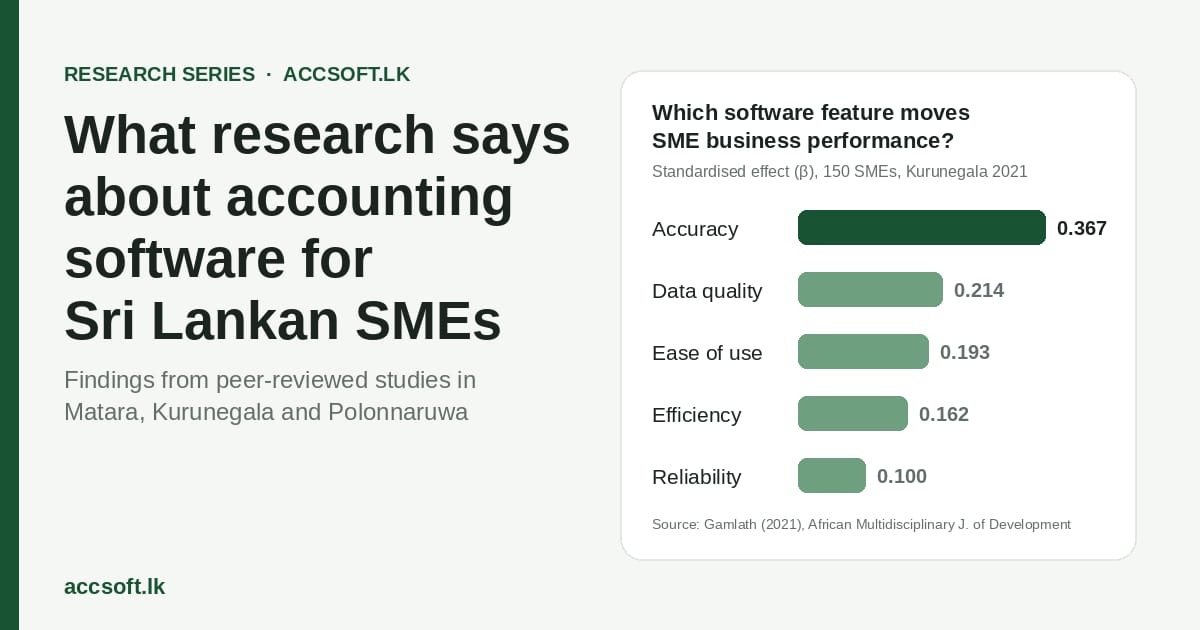
Yes, and the study that measured it in Sri Lanka is unusually specific about which features matter. In 2021, Gamlath (Vavuniya Campus, University of Jaffna) published a survey of 150 SMEs in Kurunegala District already using accounting software. It tested five software characteristics against a business performance score covering both financial and non-financial measures.
All five were significant, together explaining about 72% of the variation in business performance (R² = 0.72). But they weren't equal:
| Software characteristic | Standardised effect (β) | Significance |
|---|---|---|
| Accuracy | 0.367 | p < 0.01 |
| Data quality | 0.214 | p < 0.05 |
| Ease of use | 0.193 | p < 0.05 |
| Efficiency (speed) | 0.162 | p < 0.05 |
| Reliability | 0.100 | p < 0.05 |
Accuracy had nearly twice the effect of any other factor. Speed, the thing most demos lead with, came fourth.
The sample also shows what Sri Lankan SMEs were actually running: 26% Sage Peachtree, 16% QuickBooks, 12% Sage 50, 7% MYOB, and 39% other packages. Nearly three quarters of respondents had five years or less of experience with their software, and 77% had no more than O/L education. These weren't accountants. They were owners and clerks in retail and wholesale businesses, and the software still moved their numbers.
One caveat: the study measured performance by asking owners, not by auditing accounts. That's normal for this type of research, but it means the findings reflect what owners experienced rather than an independent P&L comparison.
What the International Evidence Adds
The Sri Lankan findings line up with SME research elsewhere, with one interesting disagreement.
Spain (2011). Grande, Estébanez and Colomina surveyed Spanish SMEs and found better performance indicators among firms that used their accounting system for tax and bank management, not just bookkeeping. The gain came from using the system across more of the business.
Iraq (2024). A study of 450 SME owners and managers found that accounting information systems partially mediated the link between business strategy and performance. In plain terms, a good strategy delivered more when there was a system behind it producing the numbers.
Oman (2025). Here's the disagreement. A study of Omani SMEs found that accounting knowledge and record-keeping discipline drove financial performance, while management support had minimal effect: the opposite of the Matara result, where management support was decisive.
The likely reconciliation: management support matters for getting the software in the door, and staff knowledge matters for getting value out of it once it's there. The Matara study measured adoption; the Oman study measured performance after adoption. Both can be right.
Two 2025 systematic reviews (one, two) reach the same overall conclusion across dozens of studies: accounting systems in SMEs are consistently associated with better performance, and the effect works through decision quality rather than cost savings on their own.
What This Means If You're Choosing Software for a Sri Lankan SME
Five things the research supports, none of which depend on which vendor you pick.
- Judge the software on accuracy first. Test how it handles VAT at 18% and SSCL at 2.5%, rounding, multi-currency, and stock valuation. In the Kurunegala data, accuracy had almost double the effect on performance of any other feature.
- Budget for the full cost, not the licence. Ability to bear the cost was one of only two significant adoption factors in Matara: implementation, data migration, training and annual support, not the price on the box.
- The owner has to lead it. Management support was the other significant factor. Software delegated to a bookkeeper without the owner's involvement is the pattern the research associates with non-adoption or stalled adoption.
- Plan for knowledge, not just installation. The Polonnaruwa and Oman studies both point to user knowledge as the driver of satisfaction and post-adoption performance. Training is where the return is realised.
- Use it beyond bookkeeping. The Spanish SMEs that gained most used their system for tax and banking, not only for recording transactions. Connect it to your VAT filing, bank reconciliation and stock, and the effect compounds.
None of this is a reason to buy AccSoft ERP or QuickBooks specifically. It's a checklist for evaluating any of them, including ours.
References
| Study | Where | Sample | Link |
|---|---|---|---|
| Darshi, G.A.N. (2019). The Adoption of Computerized Accounting System (CAS) in SMEs: Matara District, Sri Lanka. Sri Lanka Journal of Economic Research, 7(1), 77–91. | Sri Lanka | 118 SMEs | DOI |
| Gamlath, G.R.M. (2021). Impact of Characteristics of Accounting Software on Business Performance of SMEs in Kurunegala District, Sri Lanka. African Multidisciplinary Journal of Development, 10(2). | Sri Lanka | 150 SMEs | |
| Kaluarachchi, G. (2016). Adoption of Accounting Information System Practices by Entrepreneurs in Sri Lanka (Polonnaruwa District). | Sri Lanka | SMEs registered with Chamber of Commerce | SSRN |
| A Study on the Adoption of SaaS in Online Business SMEs in Sri Lanka. | Sri Lanka | 224 SMEs | Academia.edu |
| Grande, E.U., Estébanez, R.P. & Colomina, C.M. (2011). The impact of AIS on performance measures: empirical evidence in Spanish SMEs. International Journal of Digital Accounting Research, 11, 25–43. | Spain | SMEs | ResearchGate |
| The mediating role of AIS in SME strategies and organizational performance in Iraq (2024). Humanities and Social Sciences Communications. | Iraq | 450 SMEs | Nature |
| Fida, B.A. et al. (2025). The Impact of AIS on the Organizational Performance of SMEs in Oman. International Journal of Accounting and Economics Studies, 12(4), 198–204. | Oman | SMEs | IJAES |
| Implementation of AIS in SME: A Systematic Literature Review (2025). | Review | N/A | ResearchGate |
| Accounting information systems performance: A systematic literature review (2025). | Review | N/A | NASME Journal |
Frequently Asked Questions
Does accounting software actually improve SME performance?
Yes, according to the peer-reviewed evidence. A 2021 study of 150 Sri Lankan SMEs in Kurunegala found that the characteristics of their accounting software explained about 72% of the variation in business performance, and systematic reviews across dozens of international studies reach the same conclusion. The gain comes mainly through better decision-making, not just time saved.
What makes Sri Lankan SMEs adopt accounting software?
The owner's commitment and the ability to bear the full cost. In a 2019 study of 118 SMEs in Matara, these were the only two factors with a statistically significant effect on adoption. Perceived usefulness and staff skill mattered less than expected.
Which accounting software feature matters most?
Accuracy. In the Kurunegala study it had nearly twice the effect on business performance of any other feature (β = 0.367), ahead of data quality, ease of use, speed and reliability.
Which accounting software do Sri Lankan SMEs use?
In the Kurunegala sample, 26% used Sage Peachtree, 16% QuickBooks, 12% Sage 50, 7% MYOB and 39% other packages, including locally developed systems. The mix varies by district and sector.
Do you need an accountant to benefit from accounting software?
No. In the Kurunegala study, 77% of the software users surveyed had O/L education or less and most had under five years' experience with the software, yet the performance effect was still strong. Training and consistent use mattered more than qualifications.
See How AccSoft Measures Up on Accuracy
The research says accuracy matters most. Talk to us about how AccSoft ERP and our QuickBooks setup handle VAT, SSCL and stock valuation — no pressure, just a straight comparison.